Relationship Counselling in Dundrum
Are you struggling in the different types of relationships in your life right now?
Relationship counselling is not defined by romance only. Relationships are woven through every human interaction, from a smile exchanged with a stranger to the deepest bonds of love. Every person we meet is someone we are in relationship with.
Let’s pause for a moment … before we go any further … here’s a little psychological insight that may help make sense of your relationships …
It’s important to go back to the beginning, when you were born. How many relationships did you begin with? Parents, siblings, extended family? You may not remember but you might know now what these relationships were like. In your opinion, what was the quality of these relationships and their impact on you as a young developing person?
This is not an exercise in ‘blame’, it’s pure observation to learn where did your blueprint for relationships begin and could counselling in relationships in Dundrum support you.
Details
- 1 Hour sessions
- Dundrum, Dublin 14 – in-person
- Online
- €80 – €100 per session
- Insurance accepted (Aviva, Laya, VHI, Irish Life)
- IACP Accrediated
How counselling can help your relationship
My therapy isn’t just for when you believe a relationship is in crisis. The counselling is about understanding how and why you relate in your own unique way to people in your life or indeed social interactions. What is working for you and supporting healthy relationships and what is not?
It can help you with:
- Struggling with ongoing arguments or communication breakdown
- Feeling disconnected from your partner, friend, work colleague, family despite wanting the relationship to work
- Facing a big life change that’s putting strain on a relationship
- Simply asking, “Am I happy in the relationship with my partner, friend, employer etc?” and wanting clarity
Whether this is your first time in therapy or you’ve tried counselling before, sessions are tailored to your situation.

What is your attachment pattern?
Attachment pattern refers to the way you think, feel and behave in your close relationships. This pattern develops from early experiences so that’s why it’s important to go back to the beginning.
- Secure Attachment : The child feels safe exploring the world because the parenting they receive is trustworthy, available, comforting and supportive.
- Insecure – Avoidant Attachment : The child may avoid seeking parental support and comfort as the parent/caregiver may be emotionally distant and unresponsive.
- Insecure – ambivalent (resistant ) Attachment : A child can become very distressed when separated from the parent yet is difficult to comfort upon reunion. The development of this attachment style can develop when the caregiving is inconsistent – sometimes responsive , sometimes not.
- Disorganised Attachment : A child will show confused/contradictory behaviours towards a parent. They may want comfort from their parent yet avoid or fear them. This attachment is often associated with highly unpredictable caregiving that can be abusive and frightening.
Which category might you belong to?
So, take a moment and ask yourself which category might you belong to? It is important to understand that we all relate to people in our different relationship types based on our first experience of relationships, because we have developed a belief based on our experience whether to trust … or not.
Some of this is in our awareness and some of it is not … this is important to understand. Unpleasant relationship experiences in our developing years get ‘pushed down’ in to our unconscious. We do this automatically to ‘get on’ with things. We then go through life reacting to someone in a relationship from an unconscious place as we have been triggered by for example something they may have said.
We can only work with what is in our conscious awareness and it’s my job to support you with this. I have found that incorporating the Hakomi Method with general talking therapy is very beneficial to support clients to understand what is happening for them in relationships with others. The Hakomi method works with encouraging what is unconscious to come in to our present awareness.
Another little psychological insight to consider regarding your different relationships
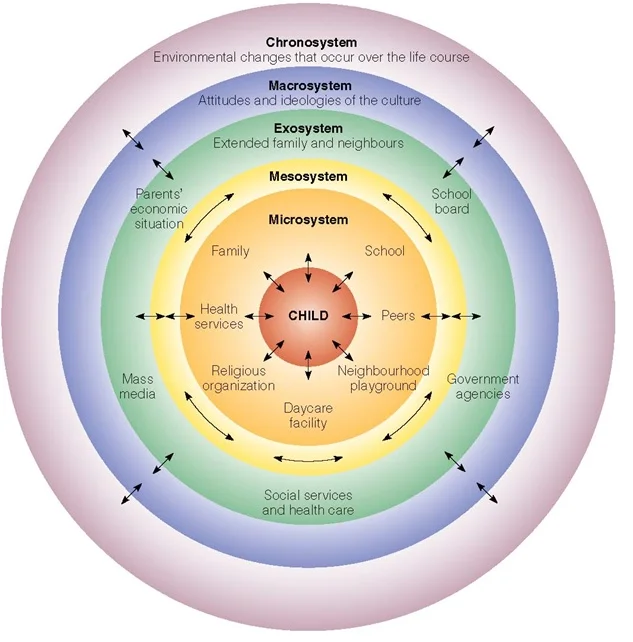
So I’ve mentioned the beginning of your life but let’s look at your life from a wider lens … The Uri Bronfenbrenner Ecological Systems Theory regarding family, school, work, community and wider society. It’s quite a mouthful! Yet at the same time it’s very informative when considering how we show up in relationships in our life now.
Please have look at the image and imagine you are the one standing in the centre, in the child space. Look at all the ‘systems’ or environments surrounding you. Can you remember or do you know now how the different types of relationships in the different environments have influenced how you relate to others in your life now?
- Microsystem – This is your immediate environment, i.e. Family, School, Peers …
- Mesosystem – This is about the connections and interaction (relationships) between the different microsystems that I’ve just mentioned above. How did your parents interact with your teachers, what did you learn about relating to others from witnessing these dynamics? What other types of interactions did you witness?
- Exosystem – These are the external social environments you are not directly part of, yet indirectly influenced by. A parent is working in a toxic work environment and becomes impacted by it; how does the parent relate to their child coming from a ‘stressed out’ state? What impact does it have on the relationship? What belief does a child develop regarding external relationships?
- Macrosysterm – These are the broader influences that impacted your immediate environment (Microsystem). How did your cultural environment influence you as a developing child? Consider the social economic impact when you were growing up? What were the government policies at the time during childhood?
- Chronosystem – This is about the ‘passing of time”, such as life transitions, historical events (wars, pandemics). Predictable changes such as starting school. Unpredictable changes such as parents divorcing. Consider the technological shift in our life time of the internet and social media.
I’m Clodagh Monaghan, and I offer counselling and therapy for individuals and couples, supporting people through the many forms and challenges of relationships. I’m based at my practice on 3 Lower Main Street, Dundrum, Dublin 14, and I also offer online sessions.
The above is a very brief introduction explaining how our Relationship Blueprint is developed and also a very important consideration when you are wondering about struggling relationships in your life. I approach supporting you in your relationships from a ‘no stone unturned’ perspective in a safe space at a pace that is comfortable to you.
With 19 years in practice.
Why choose relationship counselling in Dundrum with Clodagh Monaghan
Clodagh Monaghan has been in practice for 19 years, working with a wide range of relationship difficulties. Her training and experience include:
- BSc (Hons) in Counselling & Psychotherapy, qualified in 2007
- Qualified Clinical Supervisor in 2017
- Certified Hakomi Practitioner since 2022, a somatic mindfulness-based approach.
- QQI Accredited Train the Trainer 2016
- Lecturer/Group Clinical Supervisor for student therapists
- Continuous Professional Development workshops/trainings
This depth of training means that relationship counselling sessions go beyond surface-level support. Clodagh’s approach helps her client’s understand the deeper patterns behind their difficulties, not just managing the symptoms.
FAQ's
What to do if I’m unhappy in a relationship?
The best solution is to talk to a professional counsellor about it. With 19 years of experience, Clodagh Monaghan helps you understand what’s causing the unhappiness and find a way forward, whether that means rebuilding the relationship or gaining clarity on next steps. Contact Clodagh to get started.
How do I know if I need relationship counselling?
If you’ve noticed repeated arguments, poor communication, or find yourself asking, “Am I happy in a relationship with my partner, friend, employer etc?” Relationship counselling can help. You don’t need to be in crisis to benefit — early support often makes the biggest difference.
Is relationship counselling confidential?
Yes. Everything discussed in sessions is confidential, in line with Irish Association for Counselling & Psychotherapy ,Code of Ethics and Practice. I’m also Garda vetted, so you can feel secure and safe in the therapeutic relationship
I offer a free initial phone consultation — no pressure, no commitment.